

US–Iran War 2026: Economic Impact on Gulf Business and Global Markets
Sitting here in Dubai, looking out at the DIFC’s gleaming towers, it’s easy to feel insulated from the chaos. But talk to anyone near the Gulf Coast oil terminals, and you’ll hear a very different story. The escalating clash between the US, Israel, and Iran isn’t just a headline “over there” anymore. It’s actively bleeding into our contracts, jacking up insurance premiums, and completely upending how boards assess risk.
What started as localised strikes back in February has blown up into a massive headache for global markets. Iran’s pushback in the Strait of Hormuz, missiles, drones, and maritime chaos is strangling a waterway that handles a fifth of the world’s oil and LNG. Traders panicked in hours. Credit markets snapped to attention in days. Now, a few weeks later, every sector is scrambling to run the numbers again. Welcome to 2026, where warfare is just as financial as it is kinetic.
The Energy Jolt: Volatility Becomes the Norm
Unsurprisingly, oil blinked first. Brent crude was cruising in the low $70s before practically overnighting into the high $70s and beyond. Shippers just stopped. Hundreds of captains threw down anchor rather than risk the crossfire, and insurance rates for tankers went absolutely through the roof. We started paying a “geopolitical premium” long before a single drop of actual oil went missing. For producers here in the Gulf, it’s a weird spot to be in. Sure, high prices mean fat sovereign revenues today. But no one wants to build a billion-dollar rig when the neighborhood is on fire. As one local energy exec told me over coffee recently: “You rake it in during the spikes, but you don’t break ground on mega-projects when you can’t predict next Tuesday.” LNG is in the same boat. Europe and Asia are sweating, terrified of a Hormuz bottleneck that could reignite inflation just as central banks thought they had it cornered.
Supply Chains: The Brutal Math of Rerouting
Energy grabs the front page, but logistics is where the real pain lives. With the Gulf looking risky, shipping lines are bailing on their usual routes. Ports are jammed. Cargo insurers are having a field day repricing everything. It sounds boring until you realize what it actually means: late deliveries, skyrocketing freight costs, and cash flow bottlenecks. Dubai is built to handle shocks—its infrastructure is incredible—but no trade hub is bulletproof. A maritime hiccup here ripples fast, hitting warehouses, re-export outfits, and local mom-and-pop suppliers before you know it. One logistics CEO put it bluntly: “We’re done prioritizing efficiency. It’s all about resilience now. We’re scrambling for secondary hubs and hoarding inventory.” That’s a massive shift. Globalisation has spent the last forty years obsessed with making things cheaply. Now, the obsession is just keeping things alive.
Finance: Pricing the Fear
Markets hate waiting, so they price in the terror first. Credit spreads blew out as investors demanded way more money just to stomach the uncertainty. Anything tied to travel or discretionary spending took a beating, while gold did what gold always does when the world looks scary: it climbed. Behind the scenes, regional banks are quietly pulling back from exposed sectors. Risk committees are suddenly meeting a lot more often. A buddy of mine who runs credit at a major Gulf bank summed it up perfectly: “We used to just look at cash flow and collateral. Now? We have to underwrite the geography.” That mindset shift is going to stick. Geopolitical risk isn’t some rare event anymore; it’s a baseline metric sitting right next to interest rates.
Aviation and Tourism: Running on Vibes
Travel runs entirely on confidence. The minute airspace gets rerouted or flights are cancelled across the Middle East, people get jittery. Even if an airport is a thousand miles from the danger zone, the perception of risk kills bookings. For hotels and tour operators in Dubai and the wider region, keeping up a facade of total normalcy is absolutely critical right now. The Gulf has bounced back from worse, but this whole mess is a stark reminder of how fast consumer trust can evaporate.
The View from Iran: An Economy Under Siege
Meanwhile, Iran’s domestic economy is suffocating. Decades of sanctions had already choked off growth, and going to war has only thrown gasoline on the fire. Their currency is swinging wildly, exports are strangled, and capital is fleeing the country as fast as possible. History tells us that dragging out a fight like this permanently damages an economy’s long-term ceiling. For global money, Iran is basically a no-go zone, and every new missile launch just pushes any hope of reintegration further into the future.
The Boardroom Reality Check
Honestly, the biggest shift I’m seeing is entirely psychological. Investors aren’t just reacting to the disruption right in front of them; they’re fundamentally abandoning the idea that Gulf trade routes are permanently safe. Short-term, money is hiding. Long-term, people are hunting for opportunities in defense tech, alternative shipping routes, and energy grid security. Go into any Gulf boardroom right now, and the questions are pretty stark: Are we overly reliant on one shipping lane? Do we have enough cash to survive a six-month freeze? Are our supply chains actually secure, or just cheap? We’ve always juggled massive ambition with a messy neighborhood here in the Middle East. Sovereign wealth and top-tier infrastructure are great shock absorbers, but they aren’t magic shields. Eventually, the shooting will stop and markets will chill out. But the survival tactics companies are building today are going to stick around. If there’s one lesson to take away from this vantage point in Dubai, it’s this: tomorrow’s winners won’t treat geopolitical chaos as a freak accident. They’ll treat it as part of the daily routine. And in 2026, realizing that might be the smartest thing a business can do.
DATA INSIGHTS
Markets in Motion: How War Is Repriced
ENERGY SHOCK
Brent Crude Reacts First
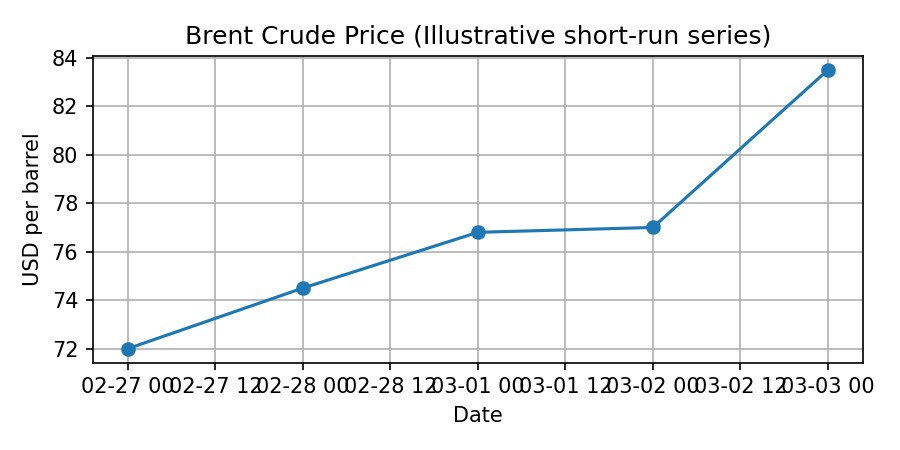
Brent climbed from the low $70s to the high $70s+ within days.
Oil did not wait for supply shortages. It moved on expectation.
The Strait of Hormuz, responsible for roughly 20% of global oil transit, became a risk variable overnight. Traders priced in disruption, insurance costs rose, and futures adjusted accordingly.
“Markets don’t wait for shortages. They price the possibility.”
Why It Matters:
Higher crude prices ripple across inflation, transport, manufacturing, and fiscal planning. For Gulf producers, the short-term revenue gain contrasts with longer-term investment uncertainty.
SHIPPING & TRADE
When Vessels Pause, Costs Rise
| date | anchored_ships_count |
| 27-02-2026 | 30 |
| 28-02-2026 | 45 |
| 01-03-2026 | 120 |
| 02-03-2026 | 420 |
| 03-03-2026 | 580 |
Hundreds of ships dropped anchor as risk escalated.
The number of vessels hesitating in Gulf waters surged as tensions intensified. Even short pauses create bottlenecks that move through the supply chain raising freight rates, delaying cargo, and tightening working capital cycles.
“Globalization optimized for cost. Crisis forces optimization for resilience.”
Why It Matters:
Logistics is the quiet transmission mechanism of geopolitical risk. When shipping slows, the cost of everything from electronics to food inches upward.
For trade hubs like Dubai, resilience infrastructure becomes a competitive advantage.
CREDIT MARKETS
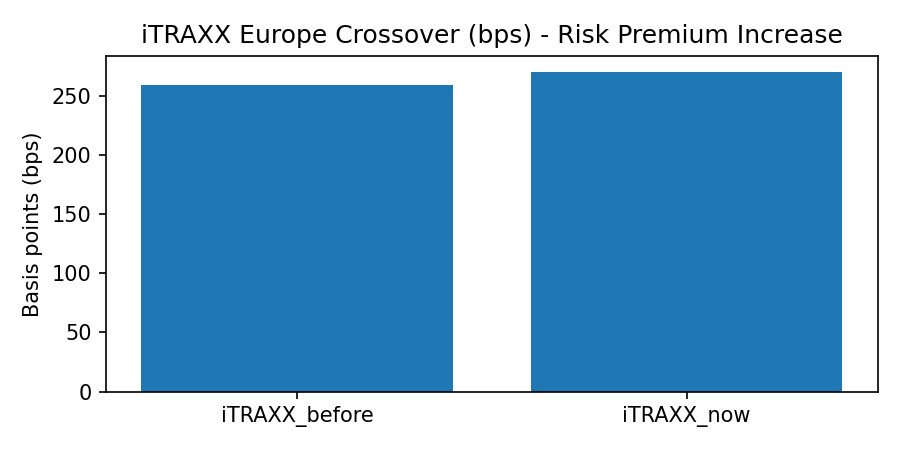
Fear Shows Up in Basis Points
Key Callout:
Corporate risk premiums widened sharply during escalation.
The iTRAXX Europe Crossover index — a barometer for high-yield credit risk — moved upward as investors demanded higher compensation to hold corporate debt.
This is how uncertainty translates into finance: through spreads.
“When spreads widen, expansion slows.”
Why It Matters:
Rising credit costs mean tighter lending, delayed projects, and cautious capital deployment. Banks and institutional investors are embedding geopolitical overlays into valuation models.