

Picture a city where 90% of government customer service runs on AI, your
property title lives on a tamper-proof blockchain, and a single app connects you
to 130+ public services without a single form, queue, or office visit. That’s not a
prototype. That’s Dubai, right now, in 2026.
The Dubai AI-first city model didn’t emerge from a single tech launch or a ribbon-
cutting ceremony. It emerged from a decade of deliberate, sometimes
uncomfortable institutional rewiring, governance first, gadgets second. And the
rest of the Gulf is watching closely.
For urban planners and policymakers in Riyadh, Doha, and Abu Dhabi, Dubai’s
experiment is the closest thing they’ll get to a real-world manual. But copying the
surface layer of the drones, the dashboards, the digital twins, without
understanding what actually made it work? That’s where the expensive mistakes
happen.
What Does It Actually Mean to Be an AI-First City?
An AI-first city treats artificial intelligence as the default operating layer for core
services, not a tool bolted onto existing systems, but the central logic that drives
traffic, governance, energy, and emergency response. Humans set the goals and
supervise outcomes; AI runs the day-to-day at scale and speed no human
bureaucracy could match.
Dubai’s 2017–2031 AI strategy, updated in the 2025 Dubai State of AI report,
commits to this principle across public safety, utilities, permitting, and the courts.
The goal isn’t automation for its own sake. It’s using AI to eliminate the friction
that erodes public trust in government: the slow permit, the missed ambulance
route, the congestion that should have been predicted three hours ago.
In 2025, Dubai climbed to 4th globally in the IMD Smart City Index, outperforming
Zurich, Oslo, and Geneva in transportation specifically. That’s not a ranking you
earn with flashy pilots. That’s what sustained, system-level integration looks like
in practice.
How Dubai Built Its AI-First City from the Ground Up
Here’s the advantage most Gulf neighbors can replicate but rarely acknowledge:
Dubai built a lot of its urban fabric new enough to embed AI from the start, not
retrofit it later at enormous cost.
Fiber and IoT sensors are installed in buildings and transit lines during
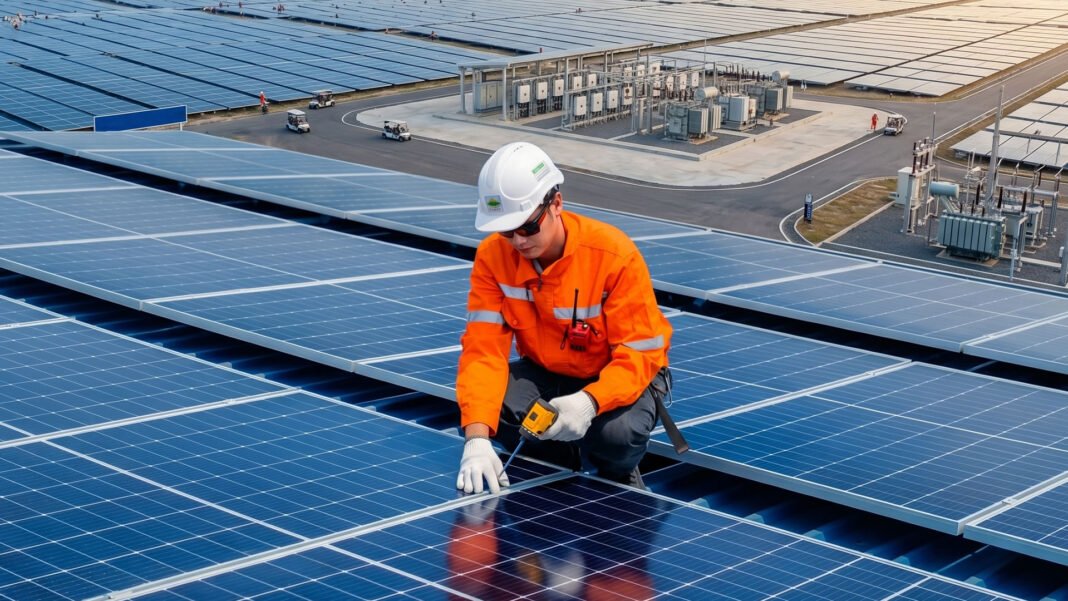
construction. The Mohammed bin Rashid Al Maktoum Solar Park, being
expanded to 5,000 MW by 2030, powers AI-heavy data centers on cheap desert
solar. Dubai Municipality uses AI tools like Building Information Modelling and
geospatial analytics that reportedly cut design timelines by up to 40% and
improve efficiency by 35%. When the physical and digital layers are designed
together, the whole system gets smarter faster.
The showpiece of this integration is Dubai Live, unveiled at GITEX Global 2025.
Think of it as the central nervous system of an entire city, one consolidated hub
pulling real-time data from thousands of sensors, 3D digital twin models, and
predictive analytics to manage roads, utilities, aviation, construction activity, and
marine transport simultaneously. Not as separate dashboards. As one operating
picture.
That’s what “AI-first” actually looks like when it’s working.
Why Dubai’s Data Strategy Is the Real Secret Weapon
Most cities that try to go “smart” end up with a collection of disconnected pilots. A
traffic app here. A health dashboard there. Nothing talks to anything else, and the
gains stay siloed in whichever department had the right budget at the right time.
Dubai avoided this, not by having better technology, but by building a data-
governance architecture that forces interoperability. Police, transport, and health
departments share platforms. When the AI-driven traffic control system talks
directly to hospital emergency dispatch, response routes adjust in real time.
Minutes saved in that conversation aren’t incremental; they’re the difference
between outcomes.
The Dubai AI and Web3 Authority sits above this, setting the rules for how the city-
wide data flows, who accesses what, and what responsible deployment looks
like. That institutional layer is unglamorous. It doesn’t get featured in tech press
releases. But without it, the cool AI projects stay forever in “pilot” mode.
What Riyadh, Doha, and Abu Dhabi Are Getting Right
The Gulf’s smart city ambitions aren’t just Dubai’s game anymore. Abu Dhabi has
committed AED 13 billion through its 2025–2027 digital strategy, aiming to
become the world’s first fully AI-powered government by creating a central digital
Authority and mandating AI-enabled service delivery across every department. InIn
March 2025, the UAE-backed Synapsia-Bold Technologies deal introduced the
Maia engine: an AI platform designed to coordinate traffic, public lighting,
transport, and city security as a single integrated system.
Saudi Arabia’s NEOM is attempting something even more radical, building a city
where AI management isn’t adopted after the fact, but is literally written into the
urban design spec from day one.
What these cities are getting right is the sequencing. They’re not just buying AI
tools; they’re investing in the governance structures, local talent pipelines, and
cross-department data agreements that make AI actually useful at scale. UAE’s
AI-focused visas, university-industry incubator programs, and startup
accelerators are seeding homegrown AI firms that now contribute to traffic
optimization, smart grid analytics, and predictive maintenance. Riyadh and Doha
are building their own versions of this ecosystem.
And crucially, they’re scaling gradually. Dubai didn’t flip a switch. It ran
neighborhood-level pilots, proved safety and public buy-in, and only then
expanded city-wide. Gulf peers are now adopting similar phase-gated rollout
plans. Traffic and energy first. Then, health, education, and social services.
The Risks Nobody Talks About
None of this comes without real trade-offs, and honest Gulf planners know it.
The most obvious: over-reliance on centralized AI creates a single point
of vulnerability. If a core AI agent fails or gets compromised, entire traffic grids or
security systems don’t just degrade; they fail. They can collapse simultaneously.
The more integrated your city’s operating system, the larger the blast radius of
any significant failure.
Then there’s the privacy question. Facial recognition cameras, predictive policing
models, and behavioral data from mobile devices are all inputs feeding Dubai’s
city-scale AI. Dubai has responded with a Responsible AI Policy framework that
requires impact assessments, transparency rules, and human-in-the-loop
safeguards for high-risk deployments. But the emirate’s posture leans more
toward “experiment and regulate later” than “regulate before you experiment.”
That’s a calculated bet. Other Gulf cities will need to decide where they sit on that
spectrum.
And public trust matters. AI governance is not just a technical problem. It’s a
social contract.
Three Lessons Every Gulf City Should Take from Dubai’s Playbook
If there’s a distillation of what Dubai has actually proven, not just demonstrated in
controlled conditions, but proven at the city scale, it comes down to three things.
Build the institutional architecture first. The technology is the easy part. The
governance layers, data sharing agreements, cross-departmental authority, and
responsible-AI policy are where smart city projects die. Dubai built these before
the platforms were fully live, not after.
Invest in local talent as seriously as infrastructure. You can’t run an AI-first
city on imported consultants. The UAE’s long-term play is building a homegrown
ecosystem of AI engineers, data scientists, and urban tech startups who
understand the local context, stay in the region, and keep the knowledge base
from leaking abroad.
Phase your rollouts and earn public buy-in. Cities that try to deploy AI
everywhere at once generate backlash, failure, and waste. Start with traffic and
energy-visible benefits; lower stakes. Then move into health, education, and
social services once the trust baseline is established.
The deeper point Dubai makes is this: an AI-first city isn’t a collection of
technology installations. It’s a different governance contract between citizens and
the state, one in which algorithms, data, and human oversight are continuously
renegotiated, not set once and left to run.
Riyadh, Doha, and Abu Dhabi are all in the middle of that renegotiation. Dubai’s
lead isn’t permanent. But the lessons it offers are too valuable and too hard-won
to ignore.