

Somewhere in a corner of Decentraland, your avatar can walk into a Carrefour,
browse a fashion boutique, then catch a movie at VOX Cinemas, all without
leaving your couch. That’s not a tech demo. That’s the Mall of the Metaverse,
launched in Dubai in 2023, and it’s one piece of a much larger story about the
Gulf metaverse economy, one that’s being written by governments, not just
startups.
While Silicon Valley has spent the last two years quietly walking back its
metaverse enthusiasm, the UAE and Saudi Arabia are doubling down. Not out of
hype. Out of strategy.
What Is the Gulf Metaverse Economy, Really?
The Gulf metaverse economy refers to the growing set of state-backed and
private investments across the UAE and Saudi Arabia that use immersive digital
environments, virtual malls, digital-twin cities, VR heritage tours, and virtual reality
estate to diversify national income beyond oil. According to a PwC/Strategy&
report, the metaverse could contribute roughly $15 billion annually to the GCC
economies by 2030, with Saudi Arabia capturing $7.6 billion of that and the UAE
taking $3.3 billion.
It’s not a single platform or product. Think of it more like a new layer of
infrastructure, the way broadband was in the early 2000s. The countries that built
the pipes early didn’t know exactly what would run through them. They built it
anyway.
Dubai’s Virtual Mall: Retail Without a Parking Lot
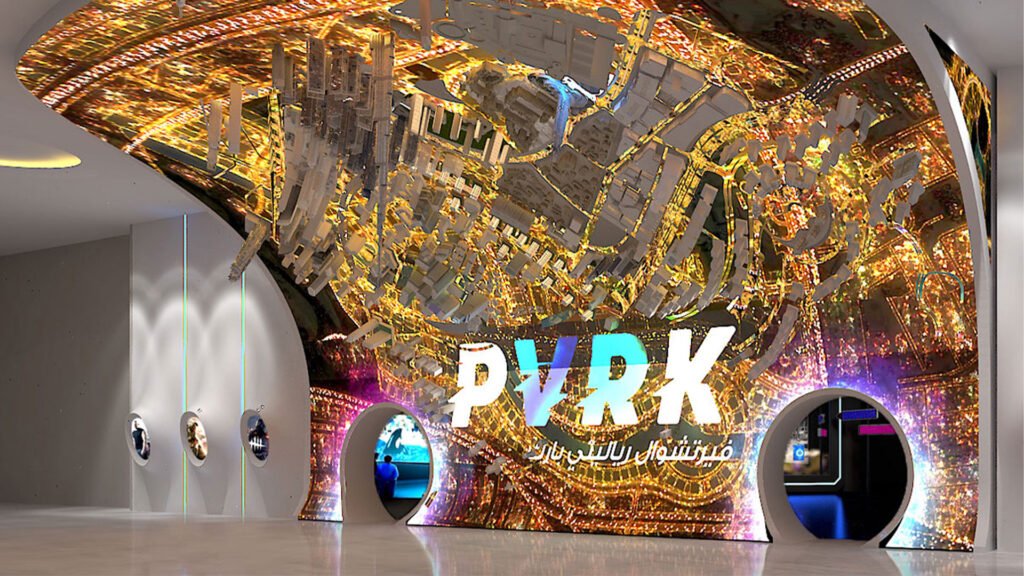
Majid Al Futtaim, the Emirati conglomerate behind some of the region’s biggest
physical malls, launched its Mall of the Metaverse in early 2023. Inside, avatars
can browse Ghawali fragrances, visit a Samsung Store, and pick up groceries
from a virtual Carrefour. The experience runs on Decentraland and is still rolling
out in phases, with the company tuning features based on actual user behavior
rather than assumptions.
Why does a company that operates some of the world’s most profitable shopping
malls care about a virtual one?
Because the customers they’re trying to keep, younger, digitally native Gulf
consumers, increasingly live online first. A virtual loyalty program, a branded
avatar experience, a digital storefront available at 2 a.m. from Riyadh or Karachi:
These aren’t replacements for the physical mall. They’re insurance policies
against the day when they might need to be.
For international brands eyeing the Middle East market, this is a working
playbook worth studying. First-mover advantage in regional metaverse
ecosystems is still very much available.
Saudi Arabia’s Metaverse Play: Concerts, Heritage, and Soft Power

Saudi Arabia came to the metaverse with a different brief. Where Dubai focused
on commerce, Riyadh focused on culture, and it turned out to be an extraordinary
distribution channel.
In 2024, the Ministry of Culture launched a national metaverse platform featuring
live performance streaming, historical districts, and mini-games accessible via
mobile, VR headset, or desktop. The platform includes virtual reconstructions of
Mada’in Saleh and Diriyah, two UNESCO-designated heritage sites, are rendered in
immersive 3D.
The logic is elegant. Saudi Arabia wants 150 million annual tourists by 2030.
Most of those tourists have never been to the Kingdom and have only vague
ideas of what it looks like. A virtual tour of AlUla, Saudi Arabia’s canyon-carved
ancient city, costs nothing to deliver, and could be the thing that convinces
someone in Seoul or São Paulo to book a flight. Strategy& estimates that travel
and tourism alone could see a $3.2 billion economic boost from metaverse
applications in the GCC. Zawya
This is soft power with a conversion funnel.
NEOM: The City Being Built Twice
No project better captures the Gulf’s metaverse ambitions than NEOM, the $500A
billion planned city rising in northwest Saudi Arabia. Before a single resident
moves in, NEOM is being built in full digital detail.
Every district, road, and building has a digital twin: a live virtual replica that
planners, engineers, and investors can walk through in VR. The idea is that by
simulating the city first, stress-testing traffic flows, modeling energy loads, and
visualizing building aesthetics, developers can avoid the catastrophically
expensive mistakes that usually happen after concrete is poured.
It’s a genuinely novel approach to urban development. And it makes the
metaverse infrastructure not a luxury, but a prerequisite.
Within NEOM, projects like the Line (a proposed 170-kilometer linear city) and
Oxagon (a floating industrial hub) are being planned and marketed through
immersive AR and VR tooling. Investors don’t get a PDF. They get a
walkthrough.
Analysts estimate NEOM could contribute around $48 billion to Saudi GDP by
2030 and create over 380,000 jobs, a meaningful share tied directly to digital
design and virtual infrastructure work.
Is Gulf Virtual Real Estate Worth Taking Seriously?
Virtual land in the Gulf metaverse isn’t just a novelty; it’s emerging as a real
transactional category with regulatory scaffolding being built around it.
Dubai-based proptech firm Square Yards expanded its 3D metaverse platform
across the GCC, specifically to serve diaspora investors who want to tour off-plan
developments in VR rather than scrolling through PDFs. The promise: inspect
finishes, walk the floor plan, understand the neighborhood, then move straight to
contract signing through a linked digital platform.
Global metaverse real estate transactions have already exceeded half a billion
dollars, with corporate buyers from banking, luxury, and real estate snapping up
virtual parcels on platforms like Decentraland and The Sandbox. Dubai’s legal
frameworks, through DIFC and the broader Dubai Metaverse Vision, are being
deliberately shaped to make the emirate the preferred jurisdiction for listing,
trading, and securing virtual real estate for international capital.
That’s not hype. That’s regulatory competition.
Why the Gulf Is Betting on the Metaverse Before It’s Ready
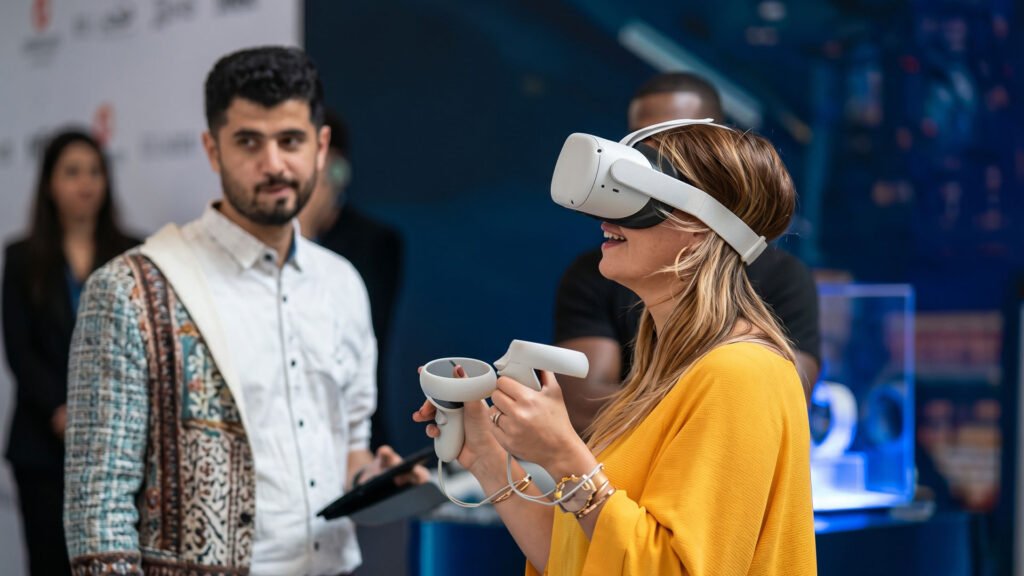
Here’s the honest version: the metaverse is not ready. Daily active users across
major metaverse platforms number in the tens of millions, not billions. Hardware
is still clunky. Interoperability between platforms barely exists. And the business
models for virtual commerce are still largely unproven at scale.
The Gulf governments know this. They’re betting anyway, and their reasoning is
sound.
The Infrastructure-First Logic
The UAE’s approach combines strategy, regulation, infrastructure investment,
and talent development, offering a model for how a government can build toward
a future technology without waiting for that technology to fully arrive.
For Dubai, the metaverse is one pillar of a larger non-oil economy play: attract
Web3 companies build digital talent pipelines and create regulatory clarity that
positions the emirate as the default address for immersive commerce in the
region. The Dubai Metaverse Strategy, launched in 2022, targets $4 billion in
GDP contribution and over 40,000 virtual jobs by 2030. Real deployments are
already live; the Dubai Electricity and Water Authority’s “DewaVerse” lets
customers access government services in a virtual environment, an early but
tangible sign of the strategy in action.
For Saudi Arabia, the calculation is slightly different. The metaverse is the
software layer over the hardware of megaprojects like NEOM, Red Sea, and
Qiddiya. You can’t build a $500 billion smart city without building its virtual twin
first. The metaverse isn’t a side experiment; it’s embedded in the architecture of
Vision 2030’s most ambitious bets.
The Verdict: Infrastructure Before Hype
The Gulf metaverse economy is not what its early headlines made it sound like.
It’s not about virtual reality as entertainment, or blockchain speculation, or
avatars attending meetings. It’s about building the digital infrastructure that the
next phase of physical economic development actually requires.
The virtual mall matters less as a retail channel and more as proof-of-concept for
immersive commerce. The NEOM digital twin matters less as a showpiece and
more as an engineering tool. The virtual heritage experiences matter less as
tourism novelties and more as the cheapest, most scalable preview of a country
that desperately wants visitors.
When the underlying technology catches up, and it will, the Gulf will already have
the frameworks, the content, the regulatory clarity, and the brand equity in place.
That’s not a gamble. That’s a very deliberate head start.
The question isn’t whether the metaverse will matter. It’s who will have built the
ground floor by the time everyone else shows up.