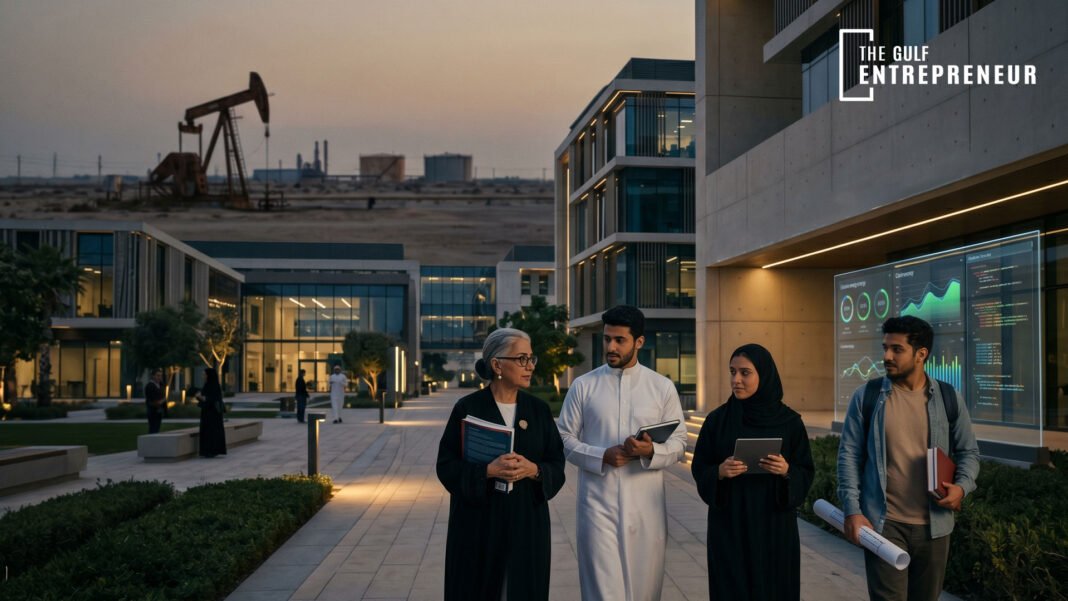


Picture a university student in Dubai choosing between a data science degree and a business administration diploma. A mother in Riyadh is watching her daughter land a corporate job that didn’t exist five years ago. A fresh engineering graduate in Abu Dhabi, wondering whether his skills are what the market actually wants. A teacher in Sharjah is retraining to use AI tools in her classroom.
These aren’t isolated moments. They’re all part of the same giant shift, the Gulf’s deliberate, high-stakes attempt to replace oil wealth with human capital. And whether you’re a student, a parent, a professional, an expat, or simply someone living in this region, this transformation is already shaping your daily reality.
According to the final 2024 data from the UAE’s Federal Competitiveness and Statistics Centre, non-oil sectors now contribute 75.5% of the UAE’s total real GDP. Think about that. Three-quarters of the UAE’s economy, the largest and most diversified in the Gulf, no longer runs on oil. It runs on trade, finance, construction, technology, and increasingly, on the skills of the people who live and work here.
That didn’t happen overnight. It happened because governments across the Gulf made a very deliberate decision: to invest in brains, not barrels.
So What Does “Replacing Oil With Education” Actually Mean?
Let’s cut through the jargon for a moment, because “economic diversification through education” sounds like something from a policy paper, not something that affects your job, your child’s school, or your salary.
Here’s what it actually means: Gulf governments are pouring money into universities, vocational training programmes, AI-powered classrooms, and workforce development schemes, all with one goal. To build economies that don’t collapse the next time oil prices crash.
And oil prices do crash. They crashed in 2014. They crashed again in 2020. Each time, the Gulf felt it. The lesson was the same every time: a region that exports only one thing is one price drop away from a crisis.
So now, instead of just exporting oil, the Gulf wants to export engineers, doctors, fintech professionals, creative entrepreneurs, and AI researchers. The shift is real. The investment is real. And the pressure on education systems, on graduates, on employers, and on governments is very real too.
Why a Skills Gap Is More Than Just a Buzz
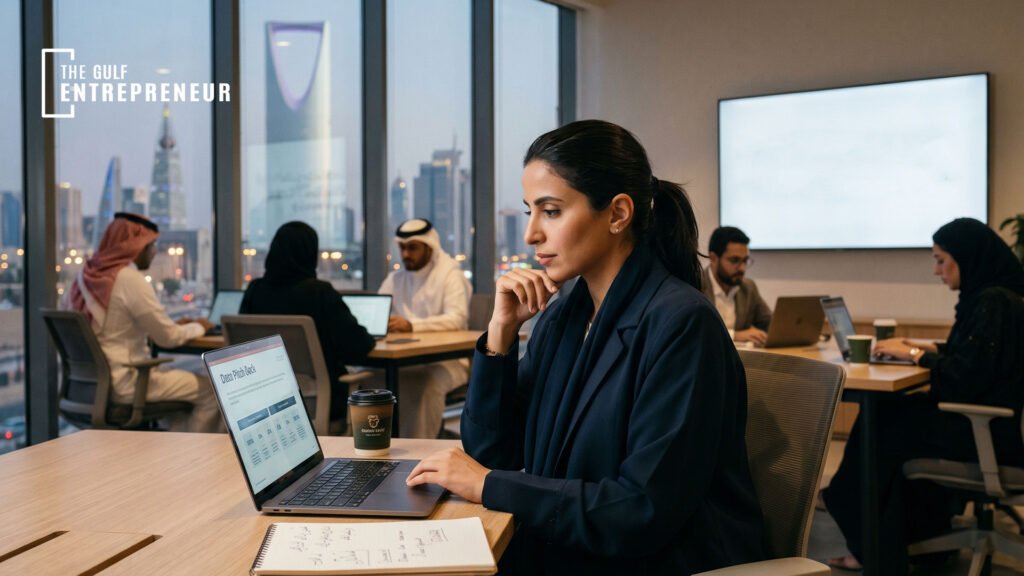
Here’s something that might surprise you: even as Gulf economies grow and diversify, a huge portion of the workforce isn’t ready for the jobs that growth is creating.
Research from Pearson puts a price tag on this mismatch in Saudi Arabia alone, SAR 62 billion in lost earnings every year for Saudi nationals, because of skills gaps and career transition inefficiencies. Include non-Saudi workers, and that figure climbs to SAR 196 billion, roughly 4.2% of the Kingdom’s entire GDP, gone. Not because people aren’t working. Because they’re working in the wrong jobs, or taking too long to move into the right ones.
Automation is making this harder. Around 23% of Saudi jobs face a high risk of displacement from technology, and the fields seeing the fastest growth (AI, cybersecurity, data analytics, advanced engineering) are exactly the ones with the deepest shortages of qualified people.
This isn’t unique to Saudi Arabia. Across the GCC, employers consistently say the same thing: graduates arrive enthusiastic but underprepared. Degrees don’t always translate into the practical skills that businesses need on day one. And the job market moves faster than any university curriculum can.
For you, reading this right now, whether you’re a student picking a major, a professional thinking about upskilling, or a parent advising your children, this is the most important context to understand. The Gulf is growing fast. But it’s growing in specific directions. And the people who thrive will be those who can read those directions clearly.
What the UAE Is Actually Building
The UAE isn’t waiting for the future to arrive. It’s building it, with serious money and some genuinely ambitious ideas.
The 2025 federal budget allocates AED 10.914 billion to public and higher education, 15.3% of the entire federal spend, up from AED 10.2 billion the year before. That’s the UAE’s largest education budget in history, and it’s not going to legacy infrastructure. It’s going to technology, skills, and innovation.
The AI Classroom Is Already Here
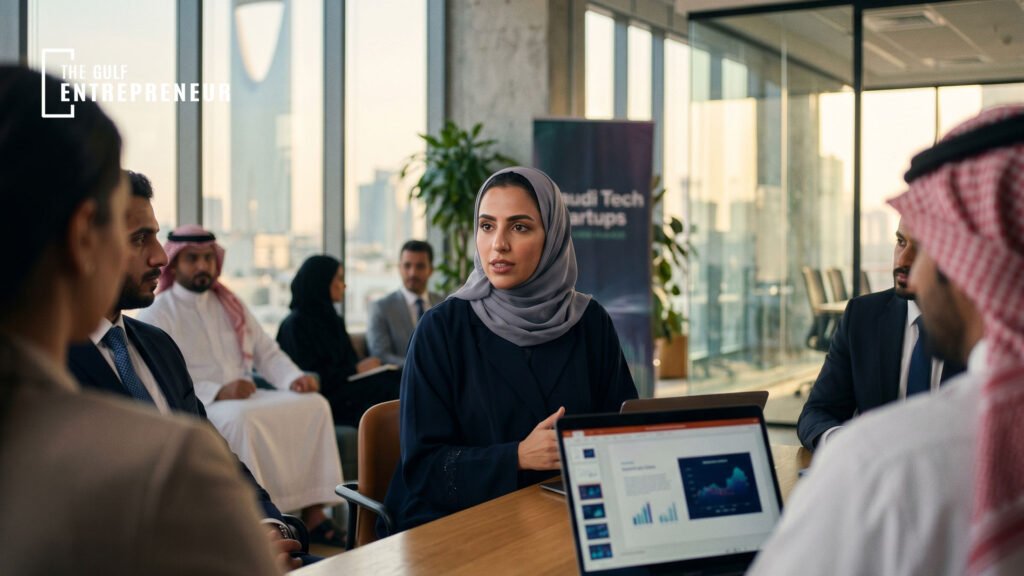
At Khalifa University in Abu Dhabi, students now have access to an AI-powered platform with a 24/7 virtual tutor, always available, always personalised. The university has also launched “KU Bee,” an AI academic advisor that helps students chart their own academic paths, flag knowledge gaps, and stay on track. As the university’s president, Prof. Ebrahim Al Hajri, described it: “The idea is not just to modernize education but to redefine it.”
This isn’t a pilot or a showcase. It’s the direction the whole system is heading.
UAE University, Zayed University, and the Higher Colleges of Technology are all aligning their programmes to the sectors the economy actually needs: engineering, healthcare, technology, and business. Not in a vague, aspirational way, but with curricula designed specifically to produce graduates who are employable in the UAE’s fastest-growing industries.
For Emiratis, programmes like Nafis, the federal initiative to support nationals in private sector jobs, are bridging the gap between education and employment with financial incentives, career development support, and clear pathways. Emiratisation targets mean companies with 50 or more employees must grow their Emirati headcount by 2% annually, rising to 4% by 2026. Non-compliance costs AED 6,000 per month per unmet position.
That’s not a suggestion. It’s the law.
Saudi Arabia Is Running Faster Than Anyone Expected
If the UAE is the region’s most polished story of diversification, Saudi Arabia is its most dramatic one.
Vision 2030, the Kingdom’s sweeping economic reform plan, has set goals that would have seemed unreachable a decade ago. The Kingdom needs to create approximately 920,000 additional jobs by 2030, according to the Konrad-Adenauer-Stiftung, most of them in sectors that barely existed in Saudi Arabia a generation ago: tourism, entertainment, technology, renewable energy, and advanced manufacturing.
To get there, Saudi Arabia has launched sector skills councils, bodies that sit directly between the education system and major industries, making sure that what universities teach actually matches what businesses need. It’s a model borrowed from Northern Europe, and it represents a serious structural shift in how the Kingdom thinks about the relationship between learning and earning.
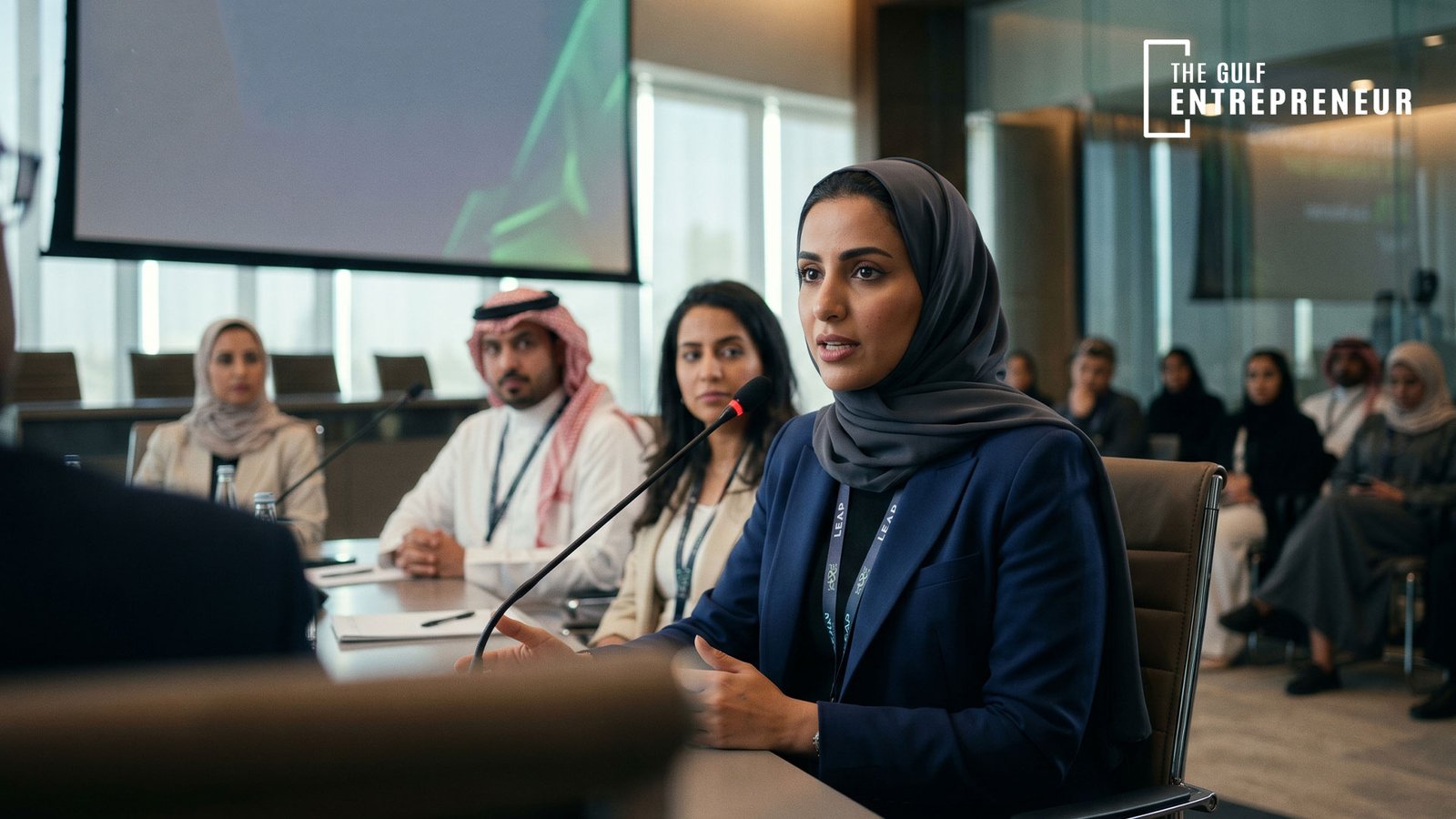
The gender story is perhaps the most striking of all. When Vision 2030 launched in 2016, women made up just 17% of Saudi Arabia’s workforce. Today, that figure stands at over 36%, surpassing the original 30% target years ahead of schedule. In less than a decade, millions of Saudi women who were previously excluded from most forms of paid employment now hold jobs, build careers, and contribute to household income.
Women now own 45% of the Kingdom’s small and medium enterprises. They work as lawyers, engineers, pilots, diplomats, and corporate executives. The cultural shift behind those numbers is enormous, and it happened because education and workforce policy changed together.
Not everything is solved, though. Youth unemployment in Saudi Arabia still sits at nearly 15%, and with the 20–24 age group projected to grow from 2.69 million in 2025 to 3.22 million by 2030, the pressure on the education-to-employment pipeline is only going to intensify.
The Part Nobody Likes to Talk About
Here’s the honest bit, the part that often gets smoothed over in official announcements.
All the investment, all the strategy, all the ambition, it only works if education actually connects to reality. And right now, across the Gulf, there’s still a meaningful gap between what universities teach and what employers need.
The problem isn’t a lack of effort. It’s a structural one. Many curricula haven’t kept pace with how fast the job market is moving. A degree in business management that doesn’t cover Islamic finance, family business dynamics, or GCC regulatory environments isn’t preparing students for the actual Gulf economy. A technology programme that skips hands-on application produces graduates who know theory but struggle on the job.
Bahrain’s Tamkeen fund, one of the region’s most proactive workforce development initiatives, supported more than 23,000 Bahrainis in individual development programmes in 2023 alone. That’s meaningful progress. But programmes like this are most effective when they’re connected to real employer demand, not just training for training’s sake.
The demographic opportunity, however, is genuinely enormous. Across MENA broadly, children and youth aged 0–24 make up around 47% of the total population. In the GCC specifically, over 50% of the local youth population is under 25 (PwC Middle East Youth Outlook). This is a generation of digital natives, many of them already entrepreneurial, globally connected, and hungry for opportunity. If the Gulf’s education reforms meet this generation halfway, the potential is extraordinary.
If they don’t, that same demographic becomes a pressure point.
What This Means for You
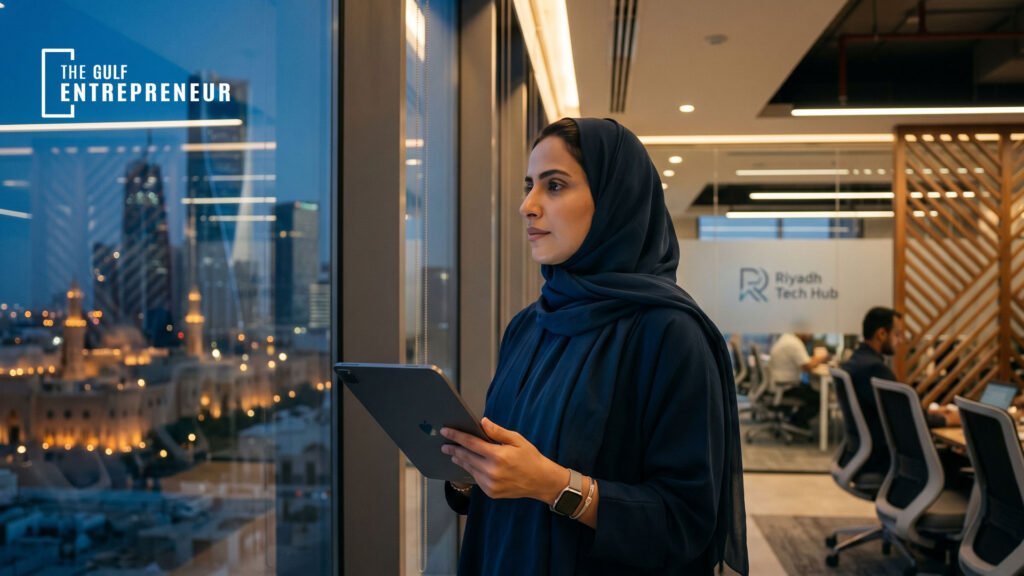
The Gulf’s economic diversification through education is not a story that belongs only to policymakers and economists. It belongs to everyone living, working, studying, or building a future in this region.
For students: the fields the Gulf is investing in, AI, data, engineering, healthcare, sustainability, and finance, are not abstract priorities. They’re where the jobs, the salaries, and the career stability will be. The degree you choose today is a bet on where the economy is heading.
For professionals: the skills gap is real, but so is the opportunity. Employers across the GCC are actively looking for people who can bridge the gap between technical knowledge and real-world application. Upskilling, especially in digital, analytical, and leadership competencies, has arguably never had a higher return.
For parents: the system is changing faster than it ever has. The careers your children will build may not exist in their current form yet. Encouraging adaptability, curiosity, and continuous learning matters as much as any specific qualification.
For employers and business leaders: workforce nationalisation isn’t going away. The companies that invest in genuinely developing their national employees, not just hitting quota numbers, will be better positioned than those that treat compliance as a checkbox.
The Gulf is further along this transition than most people outside the region realise. The investment is real. The momentum is real. The challenges are real, too.
37% of chief economists surveyed by the World Economic Forum in late 2025 expected strong or very strong growth for the MENA region, a sharp jump from just 22% earlier that year. The world is paying attention.
The oil will eventually run out. The people won’t. The question is what they’ll be equipped to do when it does.